

Unknown arrival
Enter a landscape of quiet suspense with “Unknown arrival”, a painting by Johan Kohlin. This atmospheric piece captures an empty, well-kept train station isolated under a stark cyan sky, inviting viewers to ponder its forgotten story and the people who never arrive.

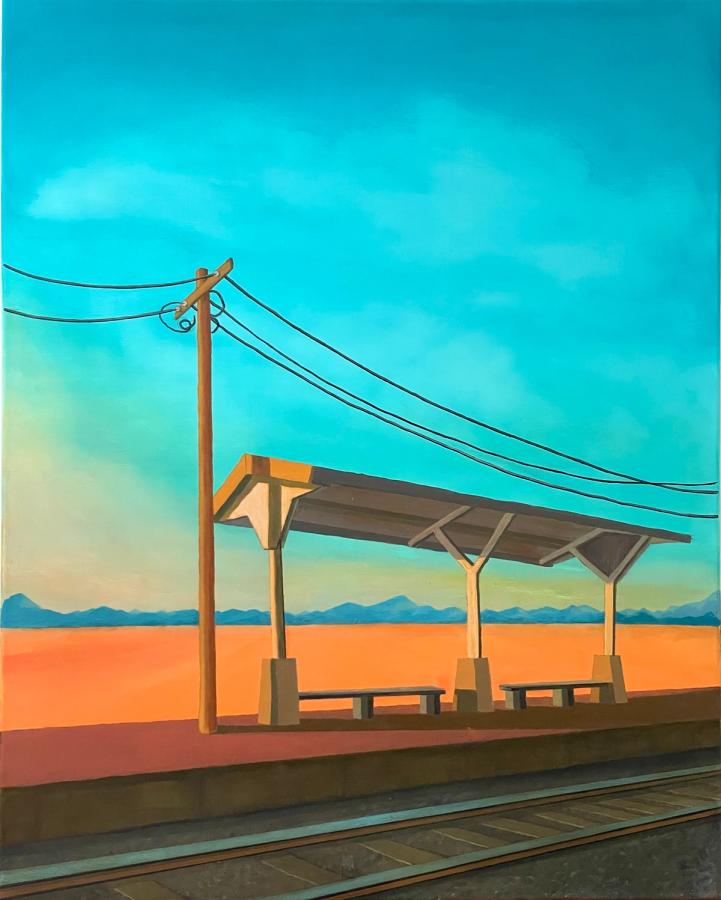
The Station That Whispers: Desolation and Color
This piece, “Unknown arrival”, is a landscape of stark contrasts and unsettling questions. It captures a moment of immaculate suspension, a place built for travel, yet utterly, beautifully empty. When my son first saw this painting, his immediate reaction was not one of observation, but of curiosity. He asked:
- "Does anyone live here?"
- "Who gets on or off? How do they get here?"
- "Does the train ever stop here?"
- "Who keeps it tidy?"
His questions define the energy of this painting. It is a space meticulously maintained, yet it offers no answers to the stories we expect from a train station.
The Artistic Vision: A Void of Saturated Color
In creating this scene, I wanted to isolate the idea of waiting. The structure itself is functional, clean benches, solid supports, and even electric wires providing power, but the environment is surreal.
The extreme color palette (the impossible cyan of the sky opposing the deep, saturated orange of the desert field) creates a high-vibrancy barrier between the platform and the rest of the world. The distant, pale mountains seem unreachable. It is a scene where comfort and desolation coexist in perfect balance.
- Medium: Acrylic on Canvas.
- Inspiration: The quietude of remote landscapes and the 'uncanny valley' of pristine, unused public spaces.
- Key Features: High-saturation color palette, precise clean lines, and an atmosphere of suspenseful silence.
The Challenge of the Final Line
- A Practice in Precision: Unlike the fluid, intuitive abstracts I create, this piece required absolute structural conviction. Watercolor, the medium used here, demands restaint. Once a flat, saturated wash of that deep cyan or that burning orange is down, there are no second chances. Every line must be intentional, as the medium allows for no opaque "covering over" to hide a mistake. The challenge lies in building a structured, realistic space without losing the luminous quality that only transparent water can provide.